
Ahoy loyal crew members, the blog is moving to.....
http://wivenhoe-sailing.blogspot.com
Monday, 19 April 2010


Sunday, 18 April 2010
Club Handicaps & Bostock Cup
To track and record my sailing progress, I have decided to publish the race results and how I have performed against handicap. I will advise that this is purely for my own reference and interest.
I have used the Results Worksheet which is published on the RYA worksheet and put together by the Portsmouth Yardstick Advisory Committee. If you like me are interested in statistics it provides fascinating results.
Standard Corrected Handicap
The way it works is as follows....
For any given race, there will be an unknown theoretical ‘best possible’ corrected time that could be achieved by a boat sailing perfectly, tacking on the right wind shifts, avoiding adverse currents, etc. In practice boats are not perfect and their crews make mistakes that cause them to sail slower than this optimum. The resultant distribution of corrected times across a fleet will typically be ‘skewed’ since it is easier to make mistakes than to avoid them. A few boats may come close to the theoretical achievable time, some will make an average number of mistakes & there will be a diminishing tail of slower boats making increasing numbers of errors. Performance assessment requires a comparison standard against which to measure each boat. If this standard is simply the average of all corrected times in a skewed distribution, it will be weighted towards the poor performance end and the majority of boats will appear to have sailed better than ‘average’, distorting the assessment. The performance standard is defined instead as the corrected time achieved by the largest group of boats; that is the peak or ‘mode’ of the distribution. Boats that achieved this Standard Corrected Time (SCT) will have sailed ‘to handicap’.
 Click on image for more detail
The YR2 procedure allows for the typical 'skewed' distribution in calculating the SCT. The average of corrected times for the top two thirds of the PY, SY & RN boats in the race gives the Average Corrected Time (ACT). ACT+5%, corresponding to the statistically average performer relative to handicap two thirds down the fleet, defines the 'poor performance' limit. The corrected times of all PY, SY & RN boats faster than ACT+5% are then averaged to give the SCT for the race. This new group of boats may be the same as the original two thirds or more or less, depending on the performance distribution in each race. The elapsed time for each boat is divided by the SCT and multiplied by 1000 to give its 'achieved performance'. Corrected times worse than ACT+5% are defined as 'poor' and should be excluded in calculating a boat's average performance for handicap assessment.
PY Handicaps
The handicaps I have used are those published by the RYA. The one assumption I have made in my calculations is that the handicaps of the Wivenhoe Ones are well established and can be included in SCT calculations.
Bostock Cup Results
 Click on image for more detail
Handicaps and statistics are very interesting things. The Xenon crossed the finish line second, came 8th out of the club handicaps and 4th in the RYA handicaps (2.3% above par on today's sail).
If you spot any obvious errors let me know.
I have used the Results Worksheet which is published on the RYA worksheet and put together by the Portsmouth Yardstick Advisory Committee. If you like me are interested in statistics it provides fascinating results.
Standard Corrected Handicap
The way it works is as follows....
For any given race, there will be an unknown theoretical ‘best possible’ corrected time that could be achieved by a boat sailing perfectly, tacking on the right wind shifts, avoiding adverse currents, etc. In practice boats are not perfect and their crews make mistakes that cause them to sail slower than this optimum. The resultant distribution of corrected times across a fleet will typically be ‘skewed’ since it is easier to make mistakes than to avoid them. A few boats may come close to the theoretical achievable time, some will make an average number of mistakes & there will be a diminishing tail of slower boats making increasing numbers of errors. Performance assessment requires a comparison standard against which to measure each boat. If this standard is simply the average of all corrected times in a skewed distribution, it will be weighted towards the poor performance end and the majority of boats will appear to have sailed better than ‘average’, distorting the assessment. The performance standard is defined instead as the corrected time achieved by the largest group of boats; that is the peak or ‘mode’ of the distribution. Boats that achieved this Standard Corrected Time (SCT) will have sailed ‘to handicap’.

The YR2 procedure allows for the typical 'skewed' distribution in calculating the SCT. The average of corrected times for the top two thirds of the PY, SY & RN boats in the race gives the Average Corrected Time (ACT). ACT+5%, corresponding to the statistically average performer relative to handicap two thirds down the fleet, defines the 'poor performance' limit. The corrected times of all PY, SY & RN boats faster than ACT+5% are then averaged to give the SCT for the race. This new group of boats may be the same as the original two thirds or more or less, depending on the performance distribution in each race. The elapsed time for each boat is divided by the SCT and multiplied by 1000 to give its 'achieved performance'. Corrected times worse than ACT+5% are defined as 'poor' and should be excluded in calculating a boat's average performance for handicap assessment.
PY Handicaps
The handicaps I have used are those published by the RYA. The one assumption I have made in my calculations is that the handicaps of the Wivenhoe Ones are well established and can be included in SCT calculations.
Bostock Cup Results

Handicaps and statistics are very interesting things. The Xenon crossed the finish line second, came 8th out of the club handicaps and 4th in the RYA handicaps (2.3% above par on today's sail).
If you spot any obvious errors let me know.
Thursday, 15 April 2010
How to Plane
So I have been going on about planing recently and have found the following top tips which we'll be putting into effect in the next race..... planing can happen in a suitably designed boat in moderate to strong winds if the crew do some or all of the following:
- Sail on a reach or broad reach to begin
- Slacken the jib
- Raise the centreboard
- Increase the speed
- Keep the hull level, trapeze if necessary
- Observe the wake until it is smooth and fast.
- Move the crew weight increasingly towards the rear to begin and to sustain planing
- Sheet in as speed increases, and apparent wind correspondingly moves forward.
- Keep the boat flat and level
- Bear away to maintain speed as necessary
- Flick or pump the sails (although there are restrictions on doing this in a race)
Wednesday, 14 April 2010
How Fast Does a Topper Xenon go?
Now that I am in my second season of racing the Topper Xenon, I am starting to get interested in just how fast we might be going!
There is a formula for calculating the maximum hull speed of a boat which is....

HSPD = maximum hull speed in knots
LWL = hull length in feet at waterline
I will need to make a few minor assuptions - the length of the Topper Xenon is 4.5m and this will be assumed to be the LWL which in feet = 14.764ft
HSPD therefore = 4.37 knots (8.1kph or 5.02 mph)
Now here's the real key thing to understand about how you are going to win races. You have got to learn to plane because when you do the formula goes out of the window.
There is a formula for calculating the maximum hull speed of a boat which is....

HSPD = maximum hull speed in knots
LWL = hull length in feet at waterline
I will need to make a few minor assuptions - the length of the Topper Xenon is 4.5m and this will be assumed to be the LWL which in feet = 14.764ft
HSPD therefore = 4.37 knots (8.1kph or 5.02 mph)
Now here's the real key thing to understand about how you are going to win races. You have got to learn to plane because when you do the formula goes out of the window.
Sunday, 11 April 2010
Spinnaker Sailing
I think we must have been a little reluctant to use the spinnaker after our near miss last week and our slight draining of confidence.That however changed in today's race..
Today's Wind (Race Start 9:30)
 Xenon Spinnaker Sailing
After seeing the WODs and the Flying Fifteen putting up their spinnakers we realised that we probably should do the same. If only we had done sooner. The lesson learned today were
I'm convinced somewhere there is a list of all the things that could possibly go wrong when you sail. As you learn to sail, you experience each one of these things on the list until you have crossed them all off and are a competent racer. Today we also learned to make sure we both know explicitly the race course and to continue to treat the mud banks with caution.
The above paragraph indicates where it went wrong today, we were running second behind the Flying Fifteen but hit the mud and let the WODs catch us, then after overtaking them we decided to go round an extra buoy (rats).
Today's Wind (Race Start 9:30)

After seeing the WODs and the Flying Fifteen putting up their spinnakers we realised that we probably should do the same. If only we had done sooner. The lesson learned today were
- provided you are on a near run, you should be ok
- you are going to get blown over if you treat your asymmetric spinnaker like a genoa. So that means when you do find yourself going over, you have got to turn down wind as soon as you can (I'm sure there is more theory to this and I'll look it up during the week.
- when you do go on the plane, the whole boat lifts out of the water and the tiller becomes very sensitive - it becomes easy to crash if you are not careful.
I'm convinced somewhere there is a list of all the things that could possibly go wrong when you sail. As you learn to sail, you experience each one of these things on the list until you have crossed them all off and are a competent racer. Today we also learned to make sure we both know explicitly the race course and to continue to treat the mud banks with caution.
The above paragraph indicates where it went wrong today, we were running second behind the Flying Fifteen but hit the mud and let the WODs catch us, then after overtaking them we decided to go round an extra buoy (rats).
Wednesday, 7 April 2010
10 Reasons why you'll never beat a Wivenhoe Sailor
They are used to the following conditions ....
- Mud banks appearing out of nowhere
- Strong tides
- Massive tidal ranges
- Gusty winds
- Narrow channels
- National class champions
- Estuarine conditions, both river and sea
- They have their own One Design
- Fiercely competitive club races every weekend
- You don't know the Colne
Sunday, 4 April 2010
When to use the Spinnaker
The Season has started again and I am back at the helm with the Barman crewing!
To start the 2010 Season, here's a few lessons learned about today's 'Can Race' at Wivenhoe Sailing Club.
The spinnaker on the Topper Xenon is both a race winner and race looser. Depending on your level of experience it could go either way but I reckon if you can use it you should and there is no other way of getting experience than trying it out.
Today's race adventure started as we headed south down the Colne and I got the Barman to put the spinnaker up. Yes we had it rigged right for once and it went up really well. I now realise we were on a bit too much of a reach to control it and we overpowered. This is when the fun started and the Barman was hanging on the side of the boat with me thinking yikes where is the safety boat....
Can Race at Wivenhoe Sailing Club
At Wivenhoe SC, this means you have to go round every buoy on the course, and with today's wind we went up to Rat Island opposite Brightlingsea - a long course.
Lessons Learned for Spinnaker

To start the 2010 Season, here's a few lessons learned about today's 'Can Race' at Wivenhoe Sailing Club.
The spinnaker on the Topper Xenon is both a race winner and race looser. Depending on your level of experience it could go either way but I reckon if you can use it you should and there is no other way of getting experience than trying it out.
Today's race adventure started as we headed south down the Colne and I got the Barman to put the spinnaker up. Yes we had it rigged right for once and it went up really well. I now realise we were on a bit too much of a reach to control it and we overpowered. This is when the fun started and the Barman was hanging on the side of the boat with me thinking yikes where is the safety boat....
Can Race at Wivenhoe Sailing Club
At Wivenhoe SC, this means you have to go round every buoy on the course, and with today's wind we went up to Rat Island opposite Brightlingsea - a long course.
Lessons Learned for Spinnaker
- The Topper Xenon's spinnaker is huge so if the winds aren't light and you are not on a broad reach it is going to overpower you.
- Don't put it up if it is blowing F4-5 (just yet anyhow!).
- If you are starting to loose it, get over the side asap and on that centre board (easier for the crew!).
- If your crew goes in the water and you are left onboard try to..
- drop the spinnaker
- point to wind
- lower the centre board fully
- furl the jib
- haul in spinnaker
- haul in crew
- avoid ditching as it will be a nightmare righting it with the spinnaker in the water and the wind.
- Keep your eye on the more experienced crews to see what they are doing.

The wind speed above is average wind speed and represents an average of F4.
Friday, 23 October 2009
I haven’t stopped sailing
I’ve just been working all hours so not had the time to write up latest adventures!
More next week when I am back from Berlin (work!).
Thursday, 15 October 2009
Video of Topper Xenon
At last a Topper Xenon video! You would have thought Topper would have promoted a few more of these. Anyhow here are some chaps in New Zealand sailing a Topper Xenon. They don’t know how lucky they are not having to negotiate mud banks and deal with tidal flows. It looks like they have awesome conditions down there - my only comment is – keep the boat flat! (but hey I’m in my study with a glass of wine…)
Sunday, 11 October 2009
Topper Topaz and Safety Boat
This weekend I was doing my bit for the Sailing Club and was helping out with the safety boat and the Club’s cadets.
We had 2 of the safety boats out, a Rib with a 50hp motor on and something called a Viking which looks to me like it was once a fishing boat or a very large tender; it gives us that stable base and a platform we can anchor on the river (Colne).
I probably found the cadets more amusing than any sailing I did on the day. There is a real mix of girls, boys, those that can, can’t sail, will continue to progress and will become, given the chance, very good sailors. Half way through the afternoon, I transferred from the safety boat to sailing one of the cadets on a Topper Topaz ; an 11 year old who informed me about his previous 6 girlfriends, his current 2 year old relationship and how he is one of the strongest in his class – all completely and very innocent!
Topper Topazs are great fun to sail and incredibly easy compared to the Xenon. It is light and goes into irons very quickly when pointing into the wind. They are extremely manoeuvrable and great fun when learning to sail.
Tuesday, 6 October 2009
Xenon real Handicap
So just what is the handicap of a Topper Xenon??
Being a good citizen I registered it at the club when I arrived as PY1070 – just like the booklet tells me.

The Lasers which I race against are ‘officially’ PY1078 and there has been some comment in the club that the handicap PY1070 is perhaps a little low ….(or we have very good Laser sailors, or I am particularly rubbish). It has even been suggested that Topper might promote low handicaps to make their boats faster!! <gasp!>
So officially at Wivenhoe Sailing Club, Topper Xenons are now rated as PY1075. This by co-incidence is the same handicap as Brightlingsea Sailing Club uses.
In my quest for the truth, I looked at a couple of other club websites and had a laugh at Erith Yacht Club who has gone totally the opposite way and has given their Topper Xenon class a local handicap of 1035!!
I suspect that a major issue is that when we race, the Barman and I are both quite heavy fella’s and this might cause some of the apparent slowness. Read here for the weight guide lines!
That said, last Sundays race went extremely well for the Barman and I. Despite the spinnaker detaching itself from the bow sprit and the forestay accidentally not been undone when the jib was rigged, we crossed the finish line a credible 2nd just behind the lead Laser. Lessons described in the blog posts below are working.
Saturday, 3 October 2009
Close Haul Tips
In my previous post I gave some hints about how best to using the cunningham to adjust tension in the luff to help point the boat - especially in light winds; it's also critical to beating the Laser sailors. On the Topper Xenon this is controlled by the helmsman so naturally I would take most interest in it.
Just to complicate things there is another rope called the outhaul and this is controlled by the crew as it is cleated off under the boom by the mast. Todate when sailing we have not touched it - just made sure it was tight - well it is my first year learning to sail after all. Guidance from Topper is as follows.....
Just to complicate things there is another rope called the outhaul and this is controlled by the crew as it is cleated off under the boom by the mast. Todate when sailing we have not touched it - just made sure it was tight - well it is my first year learning to sail after all. Guidance from Topper is as follows.....
When sailing upwind you will nearly always have the outhaul pulled quite tight but you may wish to loosen it for the downwind legs. You can pre-set the "off" position by tying a large knot (or use a ball) about an inch from the cleat when the foot is pulled tight. This means you simply have to uncleat at the windward mark and it will be in about the right place for downwind sailing. Remember to pull it back on before rounding the leeward mark!So next time we go out I will put 2 knots in it and report back how it works.
Sailing with a Cunningham
In an earlier post I highlighted that the Topper Xenon has a cunningham in oppose to a downhaul. This is not just another rope and is extremely useful when racing and of course sailing in general. If you have a Xenon you have got to learn how to use it. In our last race the Barman and I noticed a significant improvement.
The cunningham adjusts the tension in the luff extremely quickly and easily. By hauling it in or easing the line, the tension in the luff can be changed, thereby shifting the point of maximum draft forward or aft so as to optimize the sail shape.
![]()
I have found the greatest impact is when you are trying to point upwind on a close haul. If the cunningham tension is on, you don't point very high.
This bit from the Xenon manual starts to now make a bit more sense....
The cunningham adjusts the tension in the luff extremely quickly and easily. By hauling it in or easing the line, the tension in the luff can be changed, thereby shifting the point of maximum draft forward or aft so as to optimize the sail shape.

I have found the greatest impact is when you are trying to point upwind on a close haul. If the cunningham tension is on, you don't point very high.
This bit from the Xenon manual starts to now make a bit more sense....
For a medium wind (crew sitting out hard, but able to sheet the mainsail to the centreline) you should be able to use maximum power. Use very little or no cunningham. The outhaul should be set so that there is about a 3in (7-8cm) gap between mainsail foot and boom at the point of maximum chord. Try to keep the boom on the centreline, provided that the boat remains flat.
The jib can be eased about 1-2in (5-10cm) from maximum tightness for optimum performance. As the wind increases, reduce the power in the mainsail by pulling down on the cunningham progressively until the boat feels comfortable and balanced again. If you have tell tales on the leech, use enough gnav to keep them flying.
For very windy conditions flatten the main by tightening the outhaul, tensioning the cunningham further (with a fully-battened sail this has the effect of flattening the sail without pulling the fullness forward and can therefore be used much more than with a conventional mainsail). Sit out hard and sail free.
In light airs, use little or no gnav to allow the leech to open.
Sunday, 27 September 2009
Xenon Rudder
A comment I have about dinghy boats is that often are not the manuals available to show you how to fix minor problems. The only knowledge source is in the collective mind of the sailing club. For example, when I snapped all the lines in my rudder (see Man Sailing ) I was left guessing as to exactly which bolt the two lines should be threaded. Well if you have this problem, look at the two pics below and this will give you a clue.


Before the man sailing day my rudder was pulled down on a 2:1 pulley with non-stretch cord. I have made a decision that since I am likely to hit mud again that it will be a better idea to use the stretchy stuff; it's cheaper as well. It's the white cord in the image above.
Speaking of cost, I was gobsmacked by the price of a stock and tiller assembly + rudder blade. At the time of writting it is in the region of £500 - see here. To all Topper Xenon owners, look after your rudder.

Before you get too far in re-threading your stock and tiller assembly, you need to make a decision as to which type of cord you are going to use. Yes! There are 2 types of cord; that which 'gives' a bit and that which doesn't. The cord which doesn't 'give' or stretch is generally used for halyards and the like - nothing worse than sails coming down in a race and apparently the other type is more useful for sheets.

Speaking of cost, I was gobsmacked by the price of a stock and tiller assembly + rudder blade. At the time of writting it is in the region of £500 - see here. To all Topper Xenon owners, look after your rudder.
Tuesday, 22 September 2009
South vs. East Coast
I've been on holiday and away from sailing for a couple of weeks. Whilst away I was in Poole on the south coast of England; I am told it has the World's second largest natural harbour. I was very impressed with the sailing arrangements down there. There are public slipways so it is possible to launch your boat not far from the town centre - from a beach as well!!. I understand as well the tidal range is a good 3ft.
I also visited Dartmouth, home of Britannia Royal Naval College, on the River Dart. The Dart is deep, reasonably wide and long - perfect for a dinghy.

Compare and contrast that with muddy banks, salt marshes and shallow esturine rivers with +15ft tidal ranges back in Wivenhoe, Essex. They don't know how lucky they are; so watch out if I ever race you in your bit of the sea.
I also visited Dartmouth, home of Britannia Royal Naval College, on the River Dart. The Dart is deep, reasonably wide and long - perfect for a dinghy.

Compare and contrast that with muddy banks, salt marshes and shallow esturine rivers with +15ft tidal ranges back in Wivenhoe, Essex. They don't know how lucky they are; so watch out if I ever race you in your bit of the sea.
Monday, 14 September 2009
Man Sailing and Gunships
Last Sunday's sailing was tough and I have classed it as proper man sailing - apologies to all women sailors!

The Barman and I had the boat going to Brightlingsea and once the estuary opened up we got the Xenon going like a speedboat. Now the forecast said it was going to be a managable F4 wind which was perfect; unfortunately it was much stronger. On return and checking the Brightlingsea Sailing Club website (see above) we had been out in a F6 gusting +30 knots.
When we started to plane off Brightlingsea, I have to admit I was starting to get a little scared, not necessarily because of the wind but the size of the waves that we started to hit and the fast approaching shoreline directly ahead of us. To add to the man-sailing day an Apache AH64 gunship flew overhead as we were bombing along looking cool.

Now the real challenge was getting 8km back up river and maintaining control (i.e. not capsizing); as a result my tacks became real girly (I've made my apologies already).
Problems came when we found a mud bank opposite Arlesford Creek and came to a sharp halt; I had managed to get the nose pointing back down wind before both centre board and the rudder had to come up. We then found ourselves on a very difficult to control run in a foot of water, all lines on the rudder snapped again(!) and the tiller looked like it was going to break as I tried to keep us straight - it started not to be so much fun. I wasn't able to get the rudder back down properly so we had to limp the last 4km back in to Wivenhoe. All in all an exciting and challenging sail.
Update on dress in the boat - it is time for wetsuits.

When we started to plane off Brightlingsea, I have to admit I was starting to get a little scared, not necessarily because of the wind but the size of the waves that we started to hit and the fast approaching shoreline directly ahead of us. To add to the man-sailing day an Apache AH64 gunship flew overhead as we were bombing along looking cool.

Now the real challenge was getting 8km back up river and maintaining control (i.e. not capsizing); as a result my tacks became real girly (I've made my apologies already).
Problems came when we found a mud bank opposite Arlesford Creek and came to a sharp halt; I had managed to get the nose pointing back down wind before both centre board and the rudder had to come up. We then found ourselves on a very difficult to control run in a foot of water, all lines on the rudder snapped again(!) and the tiller looked like it was going to break as I tried to keep us straight - it started not to be so much fun. I wasn't able to get the rudder back down properly so we had to limp the last 4km back in to Wivenhoe. All in all an exciting and challenging sail.
Update on dress in the boat - it is time for wetsuits.
Sunday, 13 September 2009
Tealeaf in Wivenhoe
Wivenhoe has a traditional village feel about it and it is a very desirable place to live. There is a tea room, couple of pubs, spectacular views down the Colne River and always some type of community event going on. In other parts of this blog there is a video Dylan Winter has taken showing the fantastic waterfront.
All is not well though at the sailng club and not all local residents are as charming as the town they live in. Somewhere out there someone is pilfering the cruisers in the sailnig club - this evening a boat was discovered to have been raided even though it was on a mooring (albeit was in the mud at low tide) and last weekend a 4hp motor was pinched.
Sounds like we are in a den of thieves but fortunately it is only likely to be 1 or 2 people the town genuinely is a very charming place.
All is not well though at the sailng club and not all local residents are as charming as the town they live in. Somewhere out there someone is pilfering the cruisers in the sailnig club - this evening a boat was discovered to have been raided even though it was on a mooring (albeit was in the mud at low tide) and last weekend a 4hp motor was pinched.
Sounds like we are in a den of thieves but fortunately it is only likely to be 1 or 2 people the town genuinely is a very charming place.
Friday, 11 September 2009
Topper Xenon and Endeavour Championships
I could hardly own a Topper Xenon and not make mention of the RCYC Endeavour Championship.
Well, here goes - The RCYC Endeavour Championship is a unique event in the UK dinghy sailing world, recognised by the RYA as the pinnacle of that year's dinghy sailing achievements which will hail a "Champion of Champions". Held on the tidal waters of the rivers Crouch and Roach every October, it's an invitation only three day event, with the guest-list hand-picked from National Champions of selected fleets.

So I wait for my invitation and see if I am able to swap Xenons for a slightly newer model...October right? I'll save the date!
So why a Topper Xenon for this event?.......the continuing choice of the Xenon for the Endeavour Championships solves two problems at a stroke. Previous entrants considered that the RS400 (the previous boat) was a handful for lighter crews and there were occasional difficulties with availability. The Xenon's crew weight is pitched between 18 and 24 stone and Topper continues to supply all the boats so entrants need only arrive in the dinghy park to find a boat awaiting them (cheers easy).

hmmm.... at this point all I will say is my crew and I need to loose some weight...picture above is from http://rodtinsley.co.uk/ and is of Steve Tylecote and Toby Lewis who won in 2007. Looks just like me and the Barman.
ps. look how flat they have the boat
Well, here goes - The RCYC Endeavour Championship is a unique event in the UK dinghy sailing world, recognised by the RYA as the pinnacle of that year's dinghy sailing achievements which will hail a "Champion of Champions". Held on the tidal waters of the rivers Crouch and Roach every October, it's an invitation only three day event, with the guest-list hand-picked from National Champions of selected fleets.

Once the year-long preparations for the event are complete, the Topper pantechnicon arrives in Burnham containing thirty 'box-fresh' Xenons and the Topper technicians (dogs-bodies) who prepare the boats for the competitors. The Friday is a training day of Olympic standards when the entrants get the chance to familiarise themselves with the dinghy that may help to them to realise their dream "...over the hallowed waters of the Rivers Crouch and Roach". The Saturday and Sunday is a relentless progression of eight races, whatever the weather...
So I wait for my invitation and see if I am able to swap Xenons for a slightly newer model...October right? I'll save the date!
So why a Topper Xenon for this event?.......the continuing choice of the Xenon for the Endeavour Championships solves two problems at a stroke. Previous entrants considered that the RS400 (the previous boat) was a handful for lighter crews and there were occasional difficulties with availability. The Xenon's crew weight is pitched between 18 and 24 stone and Topper continues to supply all the boats so entrants need only arrive in the dinghy park to find a boat awaiting them (cheers easy).

hmmm.... at this point all I will say is my crew and I need to loose some weight...picture above is from http://rodtinsley.co.uk/ and is of Steve Tylecote and Toby Lewis who won in 2007. Looks just like me and the Barman.
ps. look how flat they have the boat
Sunday, 6 September 2009
Topper Xenon's Cunningham not Downhaul
Sailing parlance can be very confusing at times as the same thing onboard can be called a number of different names (e.g. a kicker, boom vang, gnav, thingme giggy etc). When learning to sail this doesn't help your speedy understanding of the technicalities of sail setting. Another example is the downhaul; on the Topper Xenon which is called a cunningham!
The cunningham differs from a typical downhaul in the way that it attaches to the sail. The system usually consists of a line which is secured at one end to the mast or boom below the foot of the mainsail. It is then passed through a cringle in the luff of the sail near the foot, but above the tack, and then led down on the other side to a fitting on the mast or boom or on deck.
It is named after its inventor, Briggs Swift Cunningham II, a victorious America Cup skipper, who was a yacht builder and sailor, as well as being a racecar enthusiast, driver, team owner, and racecar owner and builder. The yacht, Columbia, was led to victory by Cunningham in the America Cup competition of 1958. Briggs was inducted into the America Cup Hall of Fame in 1993. He is also in the international and American motorsports halls of fame and when innovating devices for yachting, called on the specialized talents of automobile racing friends to solve problems such as metal stress and selection.
Clipper Round the World Yacht Race
The Clipper Round the World Yacht Race has begun arriving in Hull marina, with the race starting on the 13 September 2009, it runs from Hull to Hull round the World. The reason why it is interesting is because the stripped down 68ft racing yachts are crewed by amateurs (like me), also each yacht is named after a sponsoring city, region or country.
So it must be very popular right? All you have to do is sign up at the web site here and they send you a pack!
http://www.clipperroundtheworld.com/index.php/take_part
The cynic within me thinks there must be a catch here - it can't be that easy - fill in the form - do the training - go on the race around the World.... I'd do it tomorrow ..
I think the catch is somewhere along the line someone (you?) will need to pay for the fun you have and I bet it's not cheap. Someone let me know...
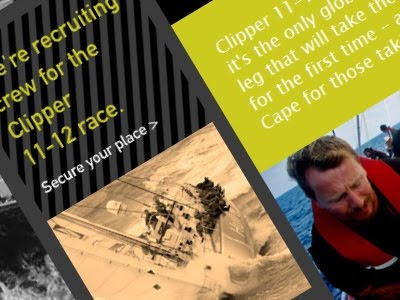
So it must be very popular right? All you have to do is sign up at the web site here and they send you a pack!
http://www.clipperroundtheworld.com/index.php/take_part
The cynic within me thinks there must be a catch here - it can't be that easy - fill in the form - do the training - go on the race around the World.... I'd do it tomorrow ..
I think the catch is somewhere along the line someone (you?) will need to pay for the fun you have and I bet it's not cheap. Someone let me know...

Subscribe to:
Posts (Atom)
